Check Engine Diagnostics
Factory-level scan, cause confirmed, written range
- Price range
- $99–$189
- Typical time
- 1–1.5 hours
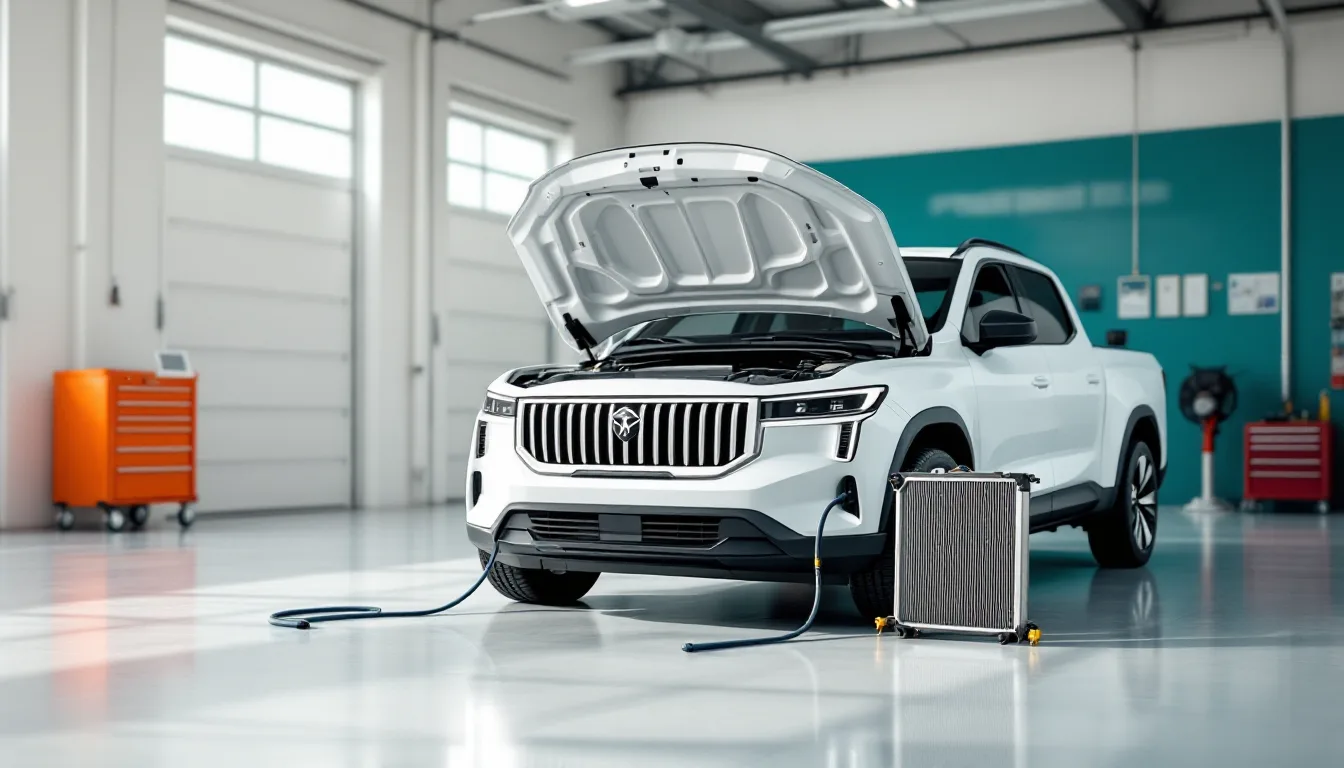
$129–$1,200 · 1–5 hours
A gauge that climbs on I-635 in July has a cause the pressure test finds in an hour. From a $129 coolant exchange to a $1,200 timing-belt water pump, you get the cause in writing and a range before any part is replaced.
All makes, published price ranges, every repair covered for 2-year/24,000-mile
Symptoms
Problem
Gauge climbs in traffic, normal on the highway
Likely cause
Cooling fan, fan relay or fan module not running, or a low charge of coolant
The fix
Fan commanded with the tool; relay, module or fan assembly replaced
Problem
Gauge climbs on the highway, normal in town
Likely cause
Thermostat stuck partly closed, a restricted radiator, or a weak water pump
The fix
Thermostat $220–$450; radiator flow tested; pump if the impeller has eroded
Problem
Coolant disappears, no puddle
Likely cause
Leak that evaporates on a hot engine, a weeping heater core, or a head gasket
The fix
Pressure test with dye; combustion test; the part found is the part quoted
Problem
Pink or orange crust on the radiator tank or hoses
Likely cause
Plastic end tank cracked, hose clamp seeping, thermostat housing split
The fix
Radiator $450–$950, hoses $150–$350, housing with the thermostat
Problem
Whine or grinding from the front, coolant weep from a hole below the pump
Likely cause
Water pump bearing and seal failing
The fix
Pump $450–$1,200 with the belt and tensioner when it drives them
Problem
White smoke, milky oil, bubbles in the reservoir
Likely cause
Head gasket or a cracked head after an overheat
The fix
Confirmed by test; quoted as engine work, with the honest option of not doing it on an old car
Turn the air conditioning off and the heater on full; the heater core is a small radiator and it buys a little time. If the gauge keeps rising or a red warning appears, pull off the road, switch the engine off and let it cool for at least half an hour. Do not open the radiator cap or the reservoir cap on a hot engine; the system is under pressure and the coolant is well above boiling.
If the level in the reservoir is visibly low once the engine is cool, water or coolant can be added to get the car to the shop a few miles away. If the engine has already overheated hard, or if steam has come from the hood, arrange a tow; the few miles to the shop are where a head gasket that survived the first overheat gives up. Describe what the gauge did when you email service@dallasmechanic.net and the shop will tell you which it is.
The engines that survive an overheat are the ones that were stopped early. Aluminium heads on modern four-cylinders warp quickly, and a car driven home in the red is the usual story behind a head gasket estimate.
The pressure test puts the system under its working pressure with the engine off and watches for the drop and the drip. Dye in the coolant and a UV lamp find the seep that evaporates before it reaches the ground. The cap is tested separately because a cap that releases early lets the coolant boil at a lower temperature and throws it into the reservoir, which looks like a leak and is not one.
The combustion gas test checks the coolant for exhaust gases, which is the direct evidence of a head gasket or a cracked head; it is done early because it changes everything about the estimate. The thermostat is checked by watching the upper hose temperature as the engine warms, the fans are commanded with the tool, the coolant is tested for concentration and condition, and on belt-driven pumps the pump is checked for play and the weep hole for staining.
The result is a written range for the part that failed, and only that part. A thermostat is not sold with a radiator unless the radiator is leaking too.
Nearly every car built in the last twenty-five years has plastic end tanks crimped to an aluminium radiator core, a plastic reservoir or degas bottle and, on many engines, a plastic thermostat housing. Plastic ages with heat cycles, and a cooling system in Dallas sees more of them than one in Minneapolis. Around eight to twelve years the tanks craze, the housings split at the hose necks and the bottles crack along a seam, and the pink or white crust where the coolant dried is the sign.
Ford trucks and Explorers, GM trucks and crossovers, Chrysler and Jeep products and many Hyundai and Kia models are regulars for the degas bottle and the radiator tank; Volkswagen and Audi for the plastic thermostat housing and the pump housing that is built into it; Honda and Toyota for the radiator tanks on cars past 150,000 miles. None of this is a defect so much as the material reaching the end of its life.
The repair is the part and fresh coolant: a radiator at $450–$950 with new hoses where they are hard and the thermostat where it is in the way; a thermostat and housing at $220–$450; hoses at $150–$350. The old parts are kept for you to see.
A pump bolted to the front of the engine and driven by the serpentine belt, which is how most Toyota, Nissan, Ford and GM engines are built, is a $450 to $700 job: the belt comes off, the pump comes off, the gasket surfaces are cleaned, and the system is refilled and bled. The belt and tensioner are inspected and quoted if they are due, since they are already off.
A pump driven by the timing belt, as on many Honda V6s, older Hyundai and Kia four-cylinders, Mitsubishi engines and some Volkswagens, sits behind the timing covers, and reaching it is the same labor as replacing the timing belt. Those pumps are quoted at the top of the range, $900 to $1,200, with the timing belt, tensioner and idlers done at the same time, because doing the pump alone and the belt later would pay for the same labor twice.
Volkswagen and Audi four-cylinders use a plastic pump module with the thermostat built in, and some newer engines use an electric pump controlled by the engine module. Both are diagnosed with the brand tool and quoted in the same range depending on access.
Coolant is not generic. Toyota uses a pink long-life formula, Honda a blue one, GM the orange dexcool OAT, Ford its own yellow and orange specifications by year, Hyundai and Kia a phosphate formula, Chrysler a purple OAT, Volkswagen G12 and G13 variants. Each is designed for the metals, seals and water pump in that engine. Mixing types, or topping a long-life coolant with a green conventional one, causes gelling and corrosion that clog radiators and heater cores.
The shop stocks the common specifications and uses the manufacturer's product, premixed or mixed with distilled water. The coolant exchange at $129–$199 drains the system, refills with the correct coolant and bleeds the air with the procedure the engine needs; many modern engines require a vacuum fill or a specific bleed sequence, and an air pocket left behind is itself a cause of overheating.
Most manufacturers put the first exchange at five years or 100,000 miles and every three to five years after that. The concentration is tested with every oil change here so the interval is based on the coolant, not on a guess.
Coolant exchange $129–$199, thermostat with housing $220–$450, hoses $150–$350, radiator $450–$950, water pump $450–$1,200. Inside each range the price moves with the coolant type and capacity, the location of the part (a thermostat under an intake manifold costs more labor than one on the end of a hose), whether the pump is belt-driven or timing-driven, and whether a plastic fitting broke during the repair as old ones often do.
Every repair is quoted in writing after the test and covered for 2 years parts and 2 years labor, up to 24,000 miles, nationwide. The A/C condenser sits in front of the radiator and is often replaced at the same time when both are damaged or when the bumper is already off; the estimate shows the shared labor.
Radiators, pumps, thermostats and hoses come from original-equipment suppliers, Denso, Aisin, Gates, Behr, Valeo, Motorcraft, ACDelco and the brand's own parts; economy radiators are avoided because their tanks fail early in heat.
Coolant is the manufacturer specification only, and every repair that opens the system includes fresh coolant and a proper bleed; a timing-belt-driven pump is replaced with the belt, tensioner and idlers as a kit.
What moves the price: coolant type and capacity, where the failed part sits, belt-driven versus timing-belt-driven pumps, and whether the radiator and condenser are replaced together.
Pricing
| Service | Price range | Typical time |
|---|---|---|
| Coolant exchange with the manufacturer's coolant and bleed | $129–$199 | about 1 hour |
| Thermostat and housing | $220–$450 | 1–2 hours |
| Radiator hoses, pair or set | $150–$350 | 1–2 hours |
| Radiator, with coolant | $450–$950 | 2–3 hours |
| Water pump (belt-driven low, timing-belt-driven with belt kit high) | $450–$1,200 | 2–5 hours |
Dallas independent-shop ranges; the pressure test names the part before the estimate is written, and a head gasket is quoted separately as engine work when the test confirms it.
The offer
Risk reversal
Covered for 2 years parts and 2 years labor, up to 24,000 miles, nationwide
No deposit, no card online: you approve the written range before any part is ordered
Published range
$129–$1,200
1–5 hours
Brands
Ford
F-150, Super Duty F-250 and F-350, Explorer and Expedition
Chevrolet
Silverado and Sierra, Tahoe, Suburban and Yukon, Equinox, Terrain and Traverse
Honda
Civic, Accord, CR-V and HR-V
Hyundai
Elantra and Accent, Sonata, Tucson and Santa Fe
Volkswagen
Jetta and Passat, Tiguan and Atlas, Golf, GTI and Golf R
Toyota
Camry and Avalon, Corolla, RAV4 and Highlander
Questions
No. A gauge in the red means the coolant is boiling or gone, and an aluminium head warps in minutes. Stop, let it cool, and tow it. A gauge that is high but not in the red on a short trip with the heater on full is a judgement call; email service@dallasmechanic.net with what the gauge is doing and the shop will tell you.
It depends entirely on the cause, which is why the pressure test comes first. A thermostat is $220–$450, hoses $150–$350, a radiator $450–$950, a water pump $450–$1,200. A fan relay or a cap can be less than any of those. A head gasket is engine work and is quoted separately after the combustion test confirms it.
Because each manufacturer specifies a chemistry for its metals, seals and pump, and the universal products are a compromise that does not match any of them fully. Mixing types gels and corrodes. The shop uses the coolant the manufacturer lists and prints it on the invoice.
When the pump is driven by the timing belt, yes, every time. The belt has to come off to reach the pump, so the labor is the same, and a belt that is halfway through its life is not worth paying the labor for twice. The estimate shows the kit with the pump.
Usually yes. A heater that goes cold while the engine is hot means coolant is not reaching the heater core, which happens when the level is low, when there is an air pocket, or when the water pump is not moving coolant. It is a useful early warning and worth booking before the gauge climbs further.
A radiator 2–3 hours, a belt-driven water pump about the same, a timing-belt-driven pump with the belt kit 4–5 hours. Most are same-day when the part is local, which it is for the common makes; the car is road tested with the temperature logged before it is handed back.
Related
Factory-level scan, cause confirmed, written range
Right oil spec, filter, inspection, reminder reset
Book Cooling System Repair in Dallas
Cooling system repair in Dallas for any make: pressure and combustion test to find the cause of overheating or coolant loss, then thermostat, radiator, water pump, hoses, fans or a coolant exchange quoted as a written range.