Brake Repair
Pads, rotors, calipers, fluid; quoted per axle
- Price range
- $249–$699 per axle
- Typical time
- 1.5–3 hours
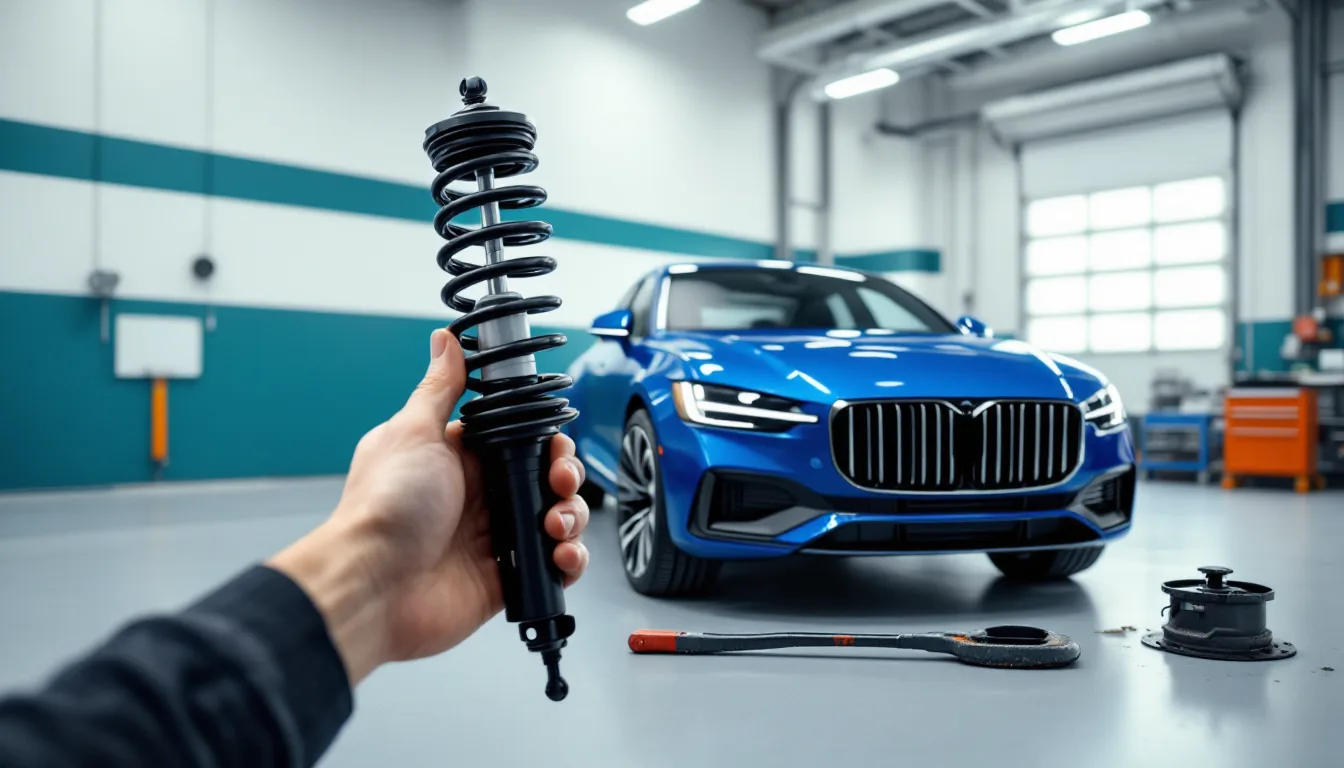
$99–$1,400 · 1–5 hours
A clunk, a hum or a wander has a part behind it. The road test and the lift check name it, and you approve a written range for that part alone, from $99 for a pair of sway bar links to $1,400 for a pair of struts.
All makes, published price ranges, every repair covered for 2-year/24,000-mile
Symptoms
Problem
Clunk over small bumps, worse on one side
Likely cause
Worn sway bar end links or sway bar bushings
The fix
Links replaced in pairs, $99–$249; bushings if the bar shifts
Problem
Knock when turning or over speed humps, steering vague
Likely cause
Ball joint or control arm bushing worn
The fix
Control arm with ball joint, $250–$650 each, then alignment
Problem
Hum that rises with speed and changes when you swerve
Likely cause
Wheel bearing failing on the side opposite the direction that quiets it
The fix
Hub or bearing replaced, $280–$650 each
Problem
Bounce after dips, nose-dive on braking, cupped tires
Likely cause
Shocks or struts worn out or leaking
The fix
Pair replaced with mounts and bearings, $600–$1,400, alignment
Problem
Creak or groan at low speed turning
Likely cause
Dry strut mount bearing, control arm bushing or spring seat
The fix
Part identified on the lift; often a mount, sometimes the strut
Problem
Pulls or wanders, tires wear on the inside edge
Likely cause
Alignment out from a pothole, or a tie rod or arm letting it drift
The fix
Worn parts first, then four-wheel alignment, $99–$149
Suspension noises are easy to hear and hard to place, and the wrong way to find them is to replace parts until the sound stops. The right way is a road test over the kind of surface you describe, a speed hump, a rough stretch of Garland Road, a parking garage ramp, with the windows down and the radio off, to hear whether the noise is a sharp clunk, a soft knock, a creak or a hum, and whether it comes on bumps, on turns or with speed.
Then the lift. With the wheels hanging and again with the suspension loaded on a drive-on lift, the technician works each joint with a pry bar: sway bar links are rocked by hand, ball joints are levered to feel for play, control arm bushings are inspected for cracks and shifting, tie rod ends are pushed and pulled, strut mounts are turned, and each wheel is spun to listen to the bearing. Shocks and struts are checked for oil on the body and for a dead bounce.
The result is a written range with each worn part on its own line. A noise that turns out to be a loose heat shield or an exhaust hanger is quoted as that, and nothing else.
A strut or shock controls how fast the spring moves. When it wears, the car floats after a dip, dives under braking, sways in a crosswind on I-30 and cups the tires. Oil on the body of the unit means the seal has gone and the damping is going with it. On most cars in Dallas, between 80,000 and 120,000 miles is where they start to show, sooner on trucks that carry loads and on cars that live on rough streets.
They are replaced in pairs across an axle because a new unit beside a worn one gives uneven damping and an unstable car in an emergency stop. On a strut, the mount, the bearing and the bump stop are replaced at the same time; the mount bearing is what creaks when you turn, and reusing it means the noise returns on new struts. Complete strut assemblies with a new spring are used where they are available and the spring is tired; otherwise the original spring is transferred with a compressor.
A pair runs $600–$1,400 depending on the vehicle: a compact sedan at the low end, a truck, a large SUV or a car with electronically adjustable dampers at the top. An alignment follows, because strut replacement changes camber and toe.
The control arm locates the wheel; its bushings absorb road shock and its ball joint lets the wheel steer and move up and down. When a bushing cracks the wheel shifts under braking and the car knocks; when a ball joint wears the steering goes vague and the wheel can, in the worst case, separate. Many modern cars sell the arm with the joint and bushings pressed in, which is why the job is quoted as an arm at $250–$650 each rather than a joint alone.
Tie rod ends and inner tie rods connect the steering rack to the wheel; wear shows as play in the steering and tire wear on the edges. They are inexpensive parts with a mandatory alignment afterward, and they are often replaced in the same visit as an arm because the labor overlaps.
Everything with a rubber bushing is torqued at ride height, with the suspension loaded, because tightening a bushing with the wheel hanging twists the rubber and it fails early. That detail is one of the differences between a repair that lasts and one that is back in a year.
A bearing starts as a faint hum at highway speed and grows into a growl you feel through the floor. The clue is that it changes when you swerve: a bearing on the left gets louder when you steer right, because the weight moves onto it. On the lift the wheel is spun by hand and the bearing is listened to and felt for roughness; a chassis ear can confirm the corner on a road test when two bearings are close.
Most cars use a sealed hub assembly bolted to the knuckle, replaced as a unit at $280–$650 depending on whether it carries the wheel speed sensor and how corroded the bolts are. Some older cars and many trucks use a pressed bearing, which takes a press and more time. The ABS sensor is checked after the job because a disturbed sensor sets a code.
Bearings fail on Dallas cars for the usual reasons: age, potholes that dent the race, and water from a creek crossing or a pressure wash past the seal. They are not replaced in pairs unless both are noisy.
An alignment sets camber, caster and toe to the manufacturer's figures. It is needed after any part that changes geometry is replaced, after a hard pothole hit, when the steering wheel is off centre, and when tires wear unevenly. It costs $99–$149 for four wheels and includes a printout of the before and after figures.
It is a waste when a worn part is still in the car, because the machine will set the numbers on a joint that moves, and the car will be out again by the time you reach the Tollway. That is why the shop checks the suspension before aligning and tells you if something has to be done first. It is also not a cure for a pull caused by a tire; tires are swapped side to side to rule that out.
Trucks that have been lifted or lowered, and cars with adjustable rear camber, need an alignment that takes account of the modification; say so when booking.
The pavement joints on I-635 and Loop 12, the expansion seams on the elevated sections of US-75, the potholes that open after every storm, apartment-complex speed humps taken ten times a day and the concrete curbs of strip-mall parking lots are the normal diet of a suspension here. Sway bar links and strut mounts take most of it, and they go first.
Trucks add load. A half-ton used for work carries tools and materials every day, and the rear shocks, the leaf spring bushings and the front ball joints wear sooner than the odometer suggests. Heat finishes the rubber: bushings and boots harden and crack in cars that sit outside through August, and once a ball joint boot splits the joint is on borrowed time.
The pattern the shop sees most is a car at 90,000 to 130,000 miles that needs links, one or two arms and struts over the space of a year. Doing the parts the inspection finds now, and watching the rest, is cheaper than doing them one at a time as each one fails.
Parts come from original-equipment suppliers and established brands: KYB, Monroe, Bilstein and Sachs for dampers, Moog, TRW, Lemförder and Mevotech for arms and links, SKF, Timken and NTN for bearings, and the brand's own parts where the aftermarket does not match them. Economy parts are not fitted on steering and suspension.
Dampers and links are replaced in pairs, arms and bearings individually unless both sides are worn; every fastener that the manufacturer lists as single-use is replaced, and everything with a bushing is torqued at ride height.
What moves the price: vehicle class, whether the arm includes the ball joint, whether a strut is sold as a complete assembly, corrosion on the fasteners, and whether an alignment is needed afterward.
Pricing
| Service | Price range | Typical time |
|---|---|---|
| Sway bar end links, pair | $99–$249 | about 1 hour |
| Struts or shocks, pair, with mounts and bearings | $600–$1,400 | 2–4 hours |
| Control arm with ball joint, each | $250–$650 | 1–2 hours |
| Wheel bearing or hub assembly, each | $280–$650 | 1–2 hours |
| Four-wheel alignment with printout | $99–$149 | about 1 hour |
Dallas independent-shop ranges per part; the estimate lists each worn part separately so you can approve the ones you want now and schedule the rest.
The offer
Risk reversal
Covered for 2 years parts and 2 years labor, up to 24,000 miles, nationwide
No deposit, no card online: you approve the written range before any part is ordered
Published range
$99–$1,400
1–5 hours
Brands
Ford
F-150, Super Duty F-250 and F-350, Explorer and Expedition
Chevrolet
Silverado and Sierra, Tahoe, Suburban and Yukon, Equinox, Terrain and Traverse
Nissan
Altima and Maxima, Sentra and Versa, Rogue and Murano
Honda
Civic, Accord, CR-V and HR-V
Hyundai
Elantra and Accent, Sonata, Tucson and Santa Fe
All makes
Mazda and Subaru, Jeep, Ram, Dodge and Chrysler, GMC, Buick and Cadillac
Questions
A sway bar link clunk is a nuisance, not a danger, and it can wait a week or two. A knock that comes with vague steering, a pull or a wheel that looks tilted is a ball joint or a tie rod, and those are a stop-driving situation because they can separate. If you cannot tell which it is, book the inspection and avoid the highway until then.
A pair on a Civic, Accord, Corolla or Camry lands toward the lower half of the $600–$1,400 range with new mounts and bearings, plus the $99–$149 alignment that follows. A RAV4, CR-V or Highlander sits higher, and a truck or a car with adaptive dampers reaches the top.
Whichever the car was designed for. Many modern arms have the joint and bushings pressed in and are sold complete, which is why the quote reads as an arm at $250–$650 each. Where a joint is a bolt-in part on its own, it is quoted that way.
Because it is a separate operation on a separate machine, and not every repair needs it. Sway bar links and shocks that do not carry the spring do not change geometry; struts, arms and tie rods do. The estimate states whether an alignment is required so there is no surprise.
Yes, with the modification taken into account on the alignment and the parts. Lifted trucks wear ball joints, tie rods and driveline parts faster, and the inspection says so plainly. Say what has been done to the truck when you book so the right parts are on hand.
Links in about an hour, a pair of struts or a control arm in 2–4 hours, a bearing in 1–2 hours, with the alignment added on. Most single-axle jobs are finished the same day when the parts are in stock locally, which they are for the common makes.
Related
Pads, rotors, calipers, fluid; quoted per axle
Right oil spec, filter, inspection, reminder reset
Scan, road test, lift, written report with photos
Book Suspension Repair in Dallas
Suspension repair in Dallas for any make: shocks and struts, control arms, ball joints, sway bar links, wheel bearings and alignment, found on a road test and a lift check and quoted as a written range per part.