Suspension Repair
Struts, control arms, bearings, links, alignment
- Price range
- $99–$1,400
- Typical time
- 1–5 hours
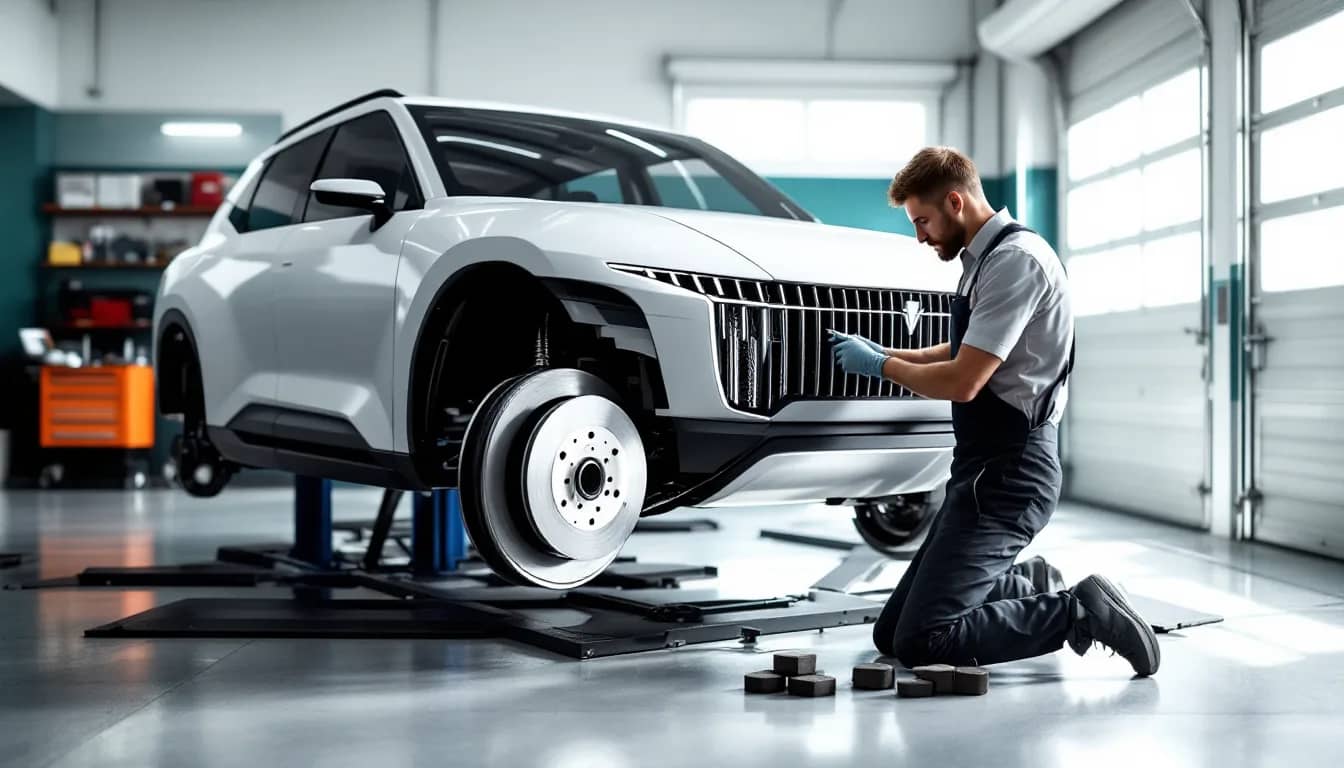
$249–$699 per axle · 1.5–3 hours
Pads and rotors per axle run $249–$699 at an independent Dallas shop depending on the vehicle. The wheels come off, the rotors are measured, and you approve a written range before a pad is fitted.
All makes, published price ranges, every repair covered for 2-year/24,000-mile
Symptoms
Problem
High-pitched squeal on light braking
Likely cause
Wear indicator touching the rotor, glazed pads, or missing shims and hardware
The fix
Measure; pads with new hardware, rotors if below minimum
Problem
Grinding on every stop
Likely cause
Pads worn to the backing plate cutting into the rotor
The fix
Pads and rotors on that axle, caliper checked for damage from the heat
Problem
Pedal pulses, wheel shakes at highway speed
Likely cause
Uneven rotor thickness from heat, or pad material transferred unevenly
The fix
New rotors and pads, bedded properly; hub face cleaned so the new rotor runs true
Problem
Pull to one side when braking
Likely cause
Seized caliper slide pin or piston on the opposite side, collapsed brake hose
The fix
Caliper service or replacement, hose if it holds pressure
Problem
Soft pedal, long travel
Likely cause
Moisture-laden fluid, air after a repair, a master cylinder bypassing, or a leak
The fix
Fluid test and exchange, leak check, master cylinder if it fails the hold test
Problem
Brake light on with the parking brake off
Likely cause
Low fluid from worn pads, a wear sensor, or an electronic parking brake fault
The fix
Pad measurement first; parking brake module read with the brand tool
Every rotor has a minimum thickness cast into its hat or edge, and the measurement with a micrometer decides the job, not the mileage or a visual glance. If the rotor is above minimum with enough left to wear through another set of pads, has no deep scoring and no thickness variation, pads alone at $149–$329 per axle are a sound repair. If it is at or near minimum, scored, or varies in thickness enough to pulse the pedal, pads and rotors at $249–$699 is the correct quote.
Rotors are rarely machined any more and for good reason: modern rotors are made thin to save weight, so a cut takes most of a worn rotor below its minimum, and a thin rotor warps faster in Dallas heat. A new rotor from the original supplier often costs less than the machining time. The exception is a heavy-duty truck rotor with plenty of material, where machining can still make sense.
The inspection happens with the wheels off and the measurements go on the estimate, so you can see the numbers behind the recommendation. Nothing is ordered until you have approved the written range.
Vehicle class first. A Corolla, Civic, Sentra or Elantra uses small single-piston calipers and inexpensive rotors and sits at the bottom of the range. A Camry, Accord, Altima, Fusion or Malibu is a step up. Crossovers and SUVs, the RAV4, CR-V, Rogue, Explorer, Equinox and Santa Fe, carry more weight on larger rotors. Half-ton trucks, the F-150, Silverado, Ram 1500, Tundra and Titan, use heavy rotors and twin-piston calipers; heavy-duty trucks and vans go beyond that. Volkswagen and other European cars add wear sensors and, on newer ones, an electronic parking brake that must be retracted with the tool.
Pad compound second. Ceramic pads are quieter, cleaner and last well in daily driving; semi-metallic pads bite harder when hot and suit trucks that tow or cars driven hard, at the cost of more dust and noise. The estimate names the compound and why.
Condition third. A caliper that has seized, a brake hose that has swollen shut, a rotor fused to the hub by corrosion or a wear sensor that has broken off in its clip adds parts or time, and each is quoted as its own line rather than hidden in the axle price.
A caliper does two things: its piston pushes the inner pad, and its slide pins let the whole body float so the outer pad wears evenly. Most calipers that look bad only need a service: the pins cleaned, new boots, fresh high-temperature grease. That is included in a pad job.
Replacement at $189–$449 each is quoted when the piston will not retract, when the piston boot is torn and the bore has rusted, when the bleeder has snapped, or when one pad on an axle is worn to the plate while the other is half gone, which is the signature of a caliper that has stopped floating. Calipers are replaced in pairs across an axle only when both show the same wear; one healthy caliper is left alone.
On Dallas cars the common caliper killer is heat plus age: rubber boots dry out, the pin grease goes hard and a caliper that was fine at 60,000 miles drags at 90,000. A dragging caliper is also the usual explanation for a car that eats one set of pads much faster than the other side.
Brake fluid absorbs moisture through the hoses and the reservoir cap, and water in the fluid lowers its boiling point. On a long downhill stop or a hard stop from highway speed on a July afternoon, fluid with three percent water can boil inside a hot caliper, and the bubble it makes is why the pedal goes to the floor for a moment. Moisture also corrodes the inside of the ABS unit, which is a far more expensive part than the fluid.
The shop tests the fluid with every brake job. If it fails for moisture or copper content, an exchange at $99–$149 is quoted: fresh DOT 3 or DOT 4 fluid of the type the cap specifies, pushed through until clean fluid reaches each bleeder, with the ABS pump cycled on cars that need it. Most manufacturers put the interval at two to three years, and few Dallas cars have had it done on time.
The exchange is also the right moment to replace a swollen brake hose or a weeping bleeder, both of which show up during the test.
Hybrids such as the Prius, the hybrid Camry, Accord and RAV4 and the Ford Escape hybrid slow down mostly through regenerative braking, so the friction brakes are used lightly and can last well past 100,000 miles. The trade-off is that pads and rotors that are rarely used corrode and seize; rear brakes on hybrids are often replaced for rust and sticking rather than wear. The brake system on many hybrids also needs the brand tool to enter a service mode before the calipers are opened.
Trucks and SUVs that tow or carry loads run their brakes hot, and that is where semi-metallic pads, quality rotors and a fluid exchange on schedule earn their keep. Rear drum brakes on some older trucks and compact cars are serviced with new shoes, hardware and a wheel cylinder check.
Volkswagen, Audi, BMW and Mercedes models use wear sensors that light the dash before the pad is gone and, on most cars built since the mid-2010s, an electronic parking brake whose motor must be wound back with the tool. Doing it with a battery and two wires is how the motor strips. The shop has the tooling, and the brake job on those cars includes the retract and reset.
The hub face is cleaned so the new rotor runs true, the hardware and slide pins are new or serviced, the lug nuts are torqued to specification with a wrench rather than an impact gun, and the pedal is pumped and checked before the car moves. The technician then drives the bedding procedure: a series of moderate stops that lay an even film of pad material on the rotor, which is what prevents the pulsation people blame on warped rotors.
For the first couple of hundred miles the brakes may feel slightly different and may smell faintly on hard stops; that is the pad curing. Noise, pulling or a pedal that changes are not normal and are covered under the 2-year/24,000-mile warranty, so email service@dallasmechanic.net rather than waiting.
Pads and rotors come from original-equipment suppliers or established aftermarket brands of equal grade, Akebono, Brembo, Bosch, Raybestos, TRW, Centric and the brand's own parts where they are the sensible choice; economy white-box parts are not fitted because they are the usual cause of noise complaints within a month.
Brake fluid is the DOT grade printed on the reservoir cap. Wear sensors, clips, shims and anti-rattle hardware are replaced rather than reused, because reused hardware is where squeals come from.
What moves the price inside the range: vehicle class and rotor size, the pad compound, whether a caliper or hose is needed, and whether the car has wear sensors or an electronic parking brake that requires the tool.
Pricing
| Service | Price range | Typical time |
|---|---|---|
| Pads and rotors, per axle | $249–$699 | 1.5–3 hours |
| Pads only, per axle (rotors measured and within specification) | $149–$329 | 1–1.5 hours |
| Brake caliper, each, fitted and bled | $189–$449 | 1–2 hours |
| Brake fluid exchange, DOT 3 or DOT 4 as specified | $99–$149 | about 1 hour |
| Check engine or ABS warning diagnosis when a brake light needs a scan | $99–$189 |
Dallas independent-shop ranges per axle; the quote for your car depends on vehicle class, pad compound and what the inspection finds, and is written before any part is ordered.
The offer
Risk reversal
Covered for 2 years parts and 2 years labor, up to 24,000 miles, nationwide
No deposit, no card online: you approve the written range before any part is ordered
Published range
$249–$699 per axle
1.5–3 hours
Brands
Ford
F-150, Super Duty F-250 and F-350, Explorer and Expedition
Chevrolet
Silverado and Sierra, Tahoe, Suburban and Yukon, Equinox, Terrain and Traverse
Toyota
Camry and Avalon, Corolla, RAV4 and Highlander
Honda
Civic, Accord, CR-V and HR-V
Volkswagen
Jetta and Passat, Tiguan and Atlas, Golf, GTI and Golf R
Questions
Toward the top of the $249–$699 per-axle range, because an F-150, Silverado, Ram 1500 or Tundra uses large rotors and twin-piston calipers, and the parts cost more than a sedan's. Trucks that tow are quoted with semi-metallic pads. The written range for your truck is set after the wheels come off and the rotors are measured.
Rarely. Modern rotors are thin enough that a cut usually takes them below minimum, and a thin rotor warps quickly in heat. When a rotor measures well above minimum with no scoring, pads only at $149–$329 is the better value; when it does not, a new rotor usually costs less than machining time.
Usually, for pads and rotors on common cars, because the parts are stocked locally and the job takes 1.5–3 hours per axle. Calipers, European wear sensors and heavy-duty truck parts can need a day. If you reach the shop in the morning with the symptom and the year and model, you are told the same day whether the car can be finished by closing.
Usually economy pads, reused hardware, or missing shims and grease on the contact points. Sometimes the rotor was left scored under new pads. The shop inspects the work and quotes the correction; often it is hardware and a proper bedding, not another set of pads.
The fluid is tested with every brake job; the exchange is a separate line at $99–$149 and is quoted only when the test shows moisture or contamination or the interval is past due. Bundling it blindly into every pad job would charge many owners for fluid that is still good.
Yes. Wear sensors are replaced with the pads and the warning clears. Electronic parking brakes are put into service mode and reset with the brand tool, which is part of the quoted job on cars that need it rather than an extra.
Related
Struts, control arms, bearings, links, alignment
Factory-level scan, cause confirmed, written range
Right oil spec, filter, inspection, reminder reset
Book Brake Repair in Dallas
Brake pads and rotors in Dallas for any make, $249–$699 per axle with the rotors measured, the calipers checked and a brake fluid test, quoted in writing after the wheels come off and covered by the shop warranty.